Social Security Benefit Optimization: 2026 COLA & Early Claiming
Anúncios
Timing your retirement filing can significantly impact your total lifetime payout, especially when cost-of-living adjustments come into play. Achieving true Social Security Benefit Optimization requires balancing the 2.8% COLA increase for 2026 against the permanent reductions associated with early claiming before full retirement age.
While taking early distributions provides immediate cash flow, it permanently lowers your base monthly allowance and shrinks the compounded growth of future inflation adjustments. Evaluating your break-even horizon, longevity expectations, and spousal payout rights helps clarify whether collecting early or delaying benefits yields higher net wealth.
Navigating shifting inflation adjustments alongside statutory age thresholds is key to maximizing your financial security in retirement. Here is how the latest cost-of-living update alters early filing economics and how to align your claiming strategy with your long-term goals.
Understanding the 2026 COLA Projection and Its Genesis
The 2.8% Cost-of-Living Adjustment (COLA) projected for 2026 stems from economic forecasts, primarily driven by inflation rates. This adjustment is crucial as it directly impacts the purchasing power of Social Security benefits for millions.
The calculation is based on the Consumer Price Index for Urban Wage Earners and Clerical Workers (CPI-W) from the third quarter of the previous year. While still a projection, this figure offers a significant benchmark for future financial planning.
Anúncios
Economic indicators suggest that inflation, though moderating, will remain a factor influencing these annual adjustments. Therefore, the 2.8% figure for 2026 reflects ongoing economic trends and their anticipated effect on retiree finances.
How COLA is Calculated
The Social Security Administration (SSA) uses a specific formula to determine the annual COLA. This involves comparing the average CPI-W for the third quarter of the current year with the average for the third quarter of the last year a COLA was enacted.
If there is an increase, the percentage difference becomes the COLA for the following year. This mechanism ensures that benefits keep pace with the rising cost of living, protecting retirees' financial stability.
Anúncios
This methodology has been in place for decades, providing a consistent and transparent process for benefit adjustments. Understanding this calculation is key to appreciating the projected 2.8% increase for 2026.
Economic Factors Driving the 2026 Projection
Several economic factors contribute to the 2.8% COLA projection for 2026, including persistent inflation in certain sectors. Energy prices, housing costs, and food prices continue to exert pressure on the overall cost of living.
Labor market dynamics and wage growth also play a role, indirectly influencing consumer spending and price levels. These interconnected elements collectively shape the economic environment that dictates COLA adjustments.
Analysts are closely monitoring global supply chains and geopolitical events, as these can introduce volatility into inflation forecasts. The 2.8% projection reflects a current consensus on these complex economic forces.
The Mechanics of Early Claiming: What You Need to Know
Early claiming of Social Security benefits allows individuals to start receiving payments as early as age 62, but this comes with a permanent reduction in monthly benefits. The decision to claim early is often driven by immediate financial needs or health considerations.
The reduction percentage depends on how many months you claim before your Full Retirement Age (FRA), which varies based on your birth year. For those with an FRA of 67, claiming at 62 results in a 30% reduction.
It is crucial to understand that this reduction is permanent; your monthly benefit will not increase to your full amount once you reach FRA. This makes the decision to claim early a significant financial commitment.
Benefit Reduction at Age 62
Claiming Social Security at age 62, the earliest possible age, results in the largest permanent reduction in benefits. For individuals with a Full Retirement Age (FRA) of 67, this translates to receiving only 70% of their primary insurance amount (PIA).
This reduction is applied to your monthly benefit for the rest of your life, impacting your overall retirement income significantly. It is a trade-off between immediate access to funds and a lower long-term payout.
The exact percentage of reduction varies slightly based on your specific FRA, but the principle remains the same: the earlier you claim, the lower your monthly payment will be.
Impact on Spousal and Survivor Benefits
The decision to claim early can also affect spousal and survivor benefits, an often-overlooked aspect of Social Security Benefit Optimization. If you claim early, your spouse's benefit, if they claim based on your record, will also be reduced.
Furthermore, if you pass away, your survivor's benefit will be based on your reduced amount, not your full retirement age benefit. This has significant implications for your family's financial security.
Careful consideration of these factors is paramount, especially for couples planning their retirement together. Understanding these ripple effects is a key component of comprehensive benefit optimization.
How the 2026 COLA Influences Early Claiming Strategies
The projected 2.8% COLA for 2026 introduces a new dynamic into early claiming strategies, potentially altering the financial calculus for many. While a COLA increases all benefits, including those reduced by early claiming, its impact must be viewed in context.
For those considering early claiming, a higher COLA means that their reduced benefit will still grow, albeit from a lower starting point. This might make early claiming appear more attractive to some, but the permanent reduction remains a significant factor.
Conversely, for those delaying, the COLA adds to an already larger base benefit, compounding the growth over time. Therefore, the 2.8% COLA highlights the ongoing trade-offs inherent in Social Security claiming decisions.

Evaluating the Trade-offs with a 2.8% COLA
The decision to claim early versus delaying benefits involves a complex trade-off, now further nuanced by the 2.8% COLA. While early claimants receive funds sooner, their base benefit is permanently reduced.
A COLA applies to this reduced amount, meaning the absolute dollar increase will be smaller compared to someone with a higher base benefit. This disparity can accumulate significantly over a long retirement period.
Therefore, individuals must weigh the immediate liquidity against the long-term compounding effect of larger annual COLA increases on a higher base benefit. This careful evaluation is central to Social Security Benefit Optimization.
Breakeven Analysis Revisited
A breakeven analysis helps determine the age at which the cumulative benefits from delaying claiming surpass those from claiming early. The 2026 2.8% COLA can slightly shift this breakeven point.
A higher COLA might marginally shorten the breakeven period for those who delay, as their larger benefit grows more rapidly in absolute terms. However, the fundamental dynamics of the breakeven analysis largely remain.
It is important to remember that these analyses are estimates and depend on individual longevity and other financial factors. Tools and calculators can help personalize these projections, making them relevant to your specific situation.
Strategies for Maximizing Benefits in Light of the 2026 COLA
To maximize Social Security benefits amidst the 2026 COLA projection, a strategic approach is essential, focusing on various factors beyond just the COLA itself. This involves carefully considering your personal circumstances, health, and other income sources.
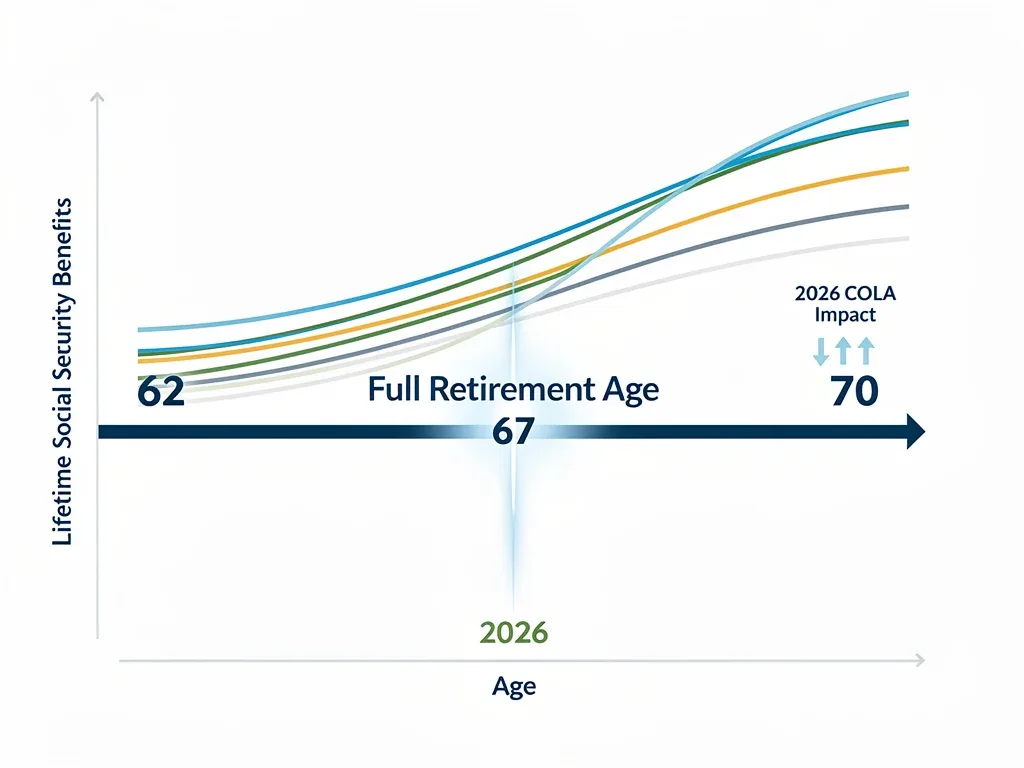
Delaying benefits past your Full Retirement Age (FRA) can lead to significant increases, up to 8% per year until age 70. This delayed retirement credit is a powerful tool for boosting lifetime income, compounded by COLA adjustments.
For couples, coordinating claiming strategies can unlock even greater combined benefits, often by having one spouse delay while the other claims earlier. This requires careful planning and understanding of spousal benefit rules.
Delaying for Higher Returns
Delaying Social Security benefits beyond your Full Retirement Age (FRA) is often touted as the most effective way to maximize your monthly payment. For each year you delay, up to age 70, your benefit increases by approximately 8%.
This guaranteed growth rate is hard to beat in most investment markets, making it a compelling option for those who can afford to wait. The 2.8% COLA for 2026 will then apply to this already enhanced benefit, leading to even larger absolute dollar increases over time.
This strategy is particularly beneficial for individuals with good health and a family history of longevity, as it ensures a higher income stream for a longer period. It is a cornerstone of effective Social Security Benefit Optimization.
Coordinating Spousal Benefits
For married couples, coordinating when each spouse claims Social Security can significantly increase their combined lifetime benefits. This is a sophisticated aspect of Social Security Benefit Optimization.
One common strategy involves the higher-earning spouse delaying their claim until age 70 to maximize their primary benefit, which then becomes the basis for a higher survivor benefit for the surviving spouse. The lower-earning spouse might claim earlier.
Another approach involves one spouse claiming early to provide immediate income, while the other delays to build a larger benefit. These decisions should be made in consultation with a financial advisor, considering the projected 2.8% COLA.
The Role of Health and Longevity in Claiming Decisions
An individual's health status and anticipated longevity are paramount considerations when determining the optimal Social Security claiming age. These personal factors often outweigh general financial advice, making the decision highly individualized.
Those with chronic health conditions or a family history of shorter lifespans might find early claiming more advantageous. Receiving benefits sooner could provide essential financial support during potentially fewer retirement years.
Conversely, individuals in excellent health with a history of longevity in their family may benefit significantly from delaying claims. This allows their benefits to grow, amplified by COLA adjustments, for a longer expected retirement.
Assessing Your Personal Longevity
Assessing your personal longevity involves more than just a guess; it requires a realistic look at your health, family history, and lifestyle choices. This self-assessment is critical for informed Social Security planning.
Factors like genetic predispositions to certain diseases, current medical conditions, and habits such as smoking or regular exercise all contribute to your expected lifespan. Tools and questionnaires can help provide a rough estimate.
While no one can predict the future, a thoughtful evaluation of longevity can significantly influence the risk-reward calculation of early versus delayed claiming, especially with the 2026 COLA in mind.
When Early Claiming Makes Sense
Despite the permanent reduction, early claiming can be the most logical choice in specific circumstances. For individuals facing severe health issues or a reduced life expectancy, immediate access to funds can be crucial.
Another scenario where early claiming is sensible is if you are experiencing significant financial hardship or unemployment and need the income to cover essential living expenses. Sometimes, the need for current income outweighs the desire for a higher future benefit.
It can also be a viable option if you have substantial other retirement income sources and view Social Security as a supplementary stream, preferring to access it sooner. Understanding these specific situations is key to proper Social Security Benefit Optimization.
The Impact of Work While Claiming Early
Working while claiming Social Security benefits before your Full Retirement Age (FRA) can lead to a temporary reduction in your benefits, a rule often misunderstood. This earnings limit applies until you reach your FRA.
In 2024, for example, if you are under FRA, the SSA deducts $1 from your benefits for every $2 you earn above $22,320. This limit typically increases each year.
Once you reach your FRA, the earnings limit no longer applies, and you can earn any amount without impacting your Social Security benefits. This rule is a critical consideration for those planning to work part-time in early retirement.
Understanding the Earnings Limit
The Social Security earnings limit is a crucial factor for anyone considering early claiming while still working. This limit dictates how much you can earn before your benefits are reduced.
The amounts change annually, so it is important to check the most current figures from the Social Security Administration. Exceeding this limit means a portion of your benefits will be withheld.
However, it is important to note that any benefits withheld due to the earnings limit are not permanently lost. They are typically added back to your monthly benefit once you reach your Full Retirement Age, effectively increasing your future payments.
Strategic Approaches to Working and Claiming
For those who wish to work in retirement, strategic planning around the earnings limit is vital for effective Social Security Benefit Optimization. Some individuals might intentionally limit their earnings to stay below the threshold.
Others might choose to delay claiming until FRA, allowing them to earn as much as they desire without any benefit reduction. This strategy combines the advantage of higher benefits with unlimited work income.
Considering the 2.8% COLA for 2026, understanding how your working income interacts with your Social Security benefits is more important than ever. It allows for a more comprehensive financial strategy that accounts for all income streams.
Financial Planning Considerations Beyond Social Security
Effective retirement planning extends far beyond just Social Security, encompassing a holistic view of all financial assets and income streams. Social Security is merely one component, albeit an important one, of a robust retirement strategy.
Consider your 401(k), IRA, pensions, and personal savings as integral parts of your financial picture. The interplay between these assets and your Social Security benefits can significantly influence your overall financial health in retirement.
Understanding how withdrawals from these accounts might affect your tax liability or Medicare premiums is also crucial. A comprehensive financial plan integrates all these elements to ensure long-term stability.
Integrating Other Retirement Accounts
Integrating your 401(k), IRA, and other retirement savings with your Social Security claiming strategy is a cornerstone of comprehensive financial planning. The goal is to create a sustainable income stream throughout retirement.
For instance, some individuals might use their personal savings to bridge the gap if they choose to delay Social Security. This allows their benefits to grow, providing a larger, inflation-adjusted income later.
Conversely, if you claim Social Security early, you might reduce withdrawals from your other accounts, preserving them for later years. This strategic balancing act is essential for effective Social Security Benefit Optimization.
Tax Implications and Medicare Premiums
The tax implications of Social Security benefits and their impact on Medicare premiums are often overlooked but critical considerations. A portion of your Social Security benefits may be taxable depending on your combined income.
Furthermore, higher income in retirement can lead to higher Medicare Part B and Part D premiums, known as Income-Related Monthly Adjustment Amounts (IRMAA). This can significantly increase your healthcare costs.
Therefore, when planning your Social Security claiming strategy, especially with the 2026 COLA in mind, it is vital to consult with a tax professional. They can help you understand how your decisions will affect your overall financial burden.
Expert Insights and Recommendations
Financial experts consistently emphasize the importance of personalized advice when it comes to Social Security claiming. Generic recommendations often fail to account for the unique circumstances of each individual or couple.
Many advisors recommend using online calculators and consulting with a qualified financial planner to model various scenarios. This personalized approach helps in making informed decisions that align with your specific goals.
The complexity of Social Security rules, coupled with factors like the 2026 COLA, necessitates professional guidance. Expert insights can illuminate potential pitfalls and opportunities that might otherwise be missed.
When to Seek Professional Advice
Seeking professional advice is highly recommended when navigating the complexities of Social Security claiming, particularly with the projected 2.8% COLA for 2026. A financial advisor specializing in retirement planning can offer invaluable guidance.
They can help you analyze your personal financial situation, including other assets, debts, and income sources, to determine the optimal claiming strategy. This comprehensive review is crucial for maximizing lifetime benefits.
Furthermore, an advisor can help you understand the tax implications of your choices and how they might affect your overall retirement income. This expert perspective is essential for sound Social Security Benefit Optimization.
Utilizing Online Calculators and Resources
Numerous online calculators and resources are available to help individuals estimate their Social Security benefits under different claiming scenarios. These tools can be a valuable starting point for your research.
The Social Security Administration's website offers personalized statements and calculators that provide estimates based on your earnings record. These official resources are highly accurate and should be your primary reference.
While online tools are helpful, they should complement, not replace, personalized professional advice. They can provide a good overview but may not capture all the nuances of your unique financial situation, especially concerning the 2026 COLA.
The Future Outlook for Social Security and COLA Adjustments
The future outlook for Social Security involves ongoing discussions about its long-term solvency and potential reforms. These broader conversations can influence future COLA adjustments and benefit structures.
While the 2.8% COLA for 2026 provides immediate clarity, understanding the program's long-term trajectory is crucial for sustained financial planning. The trust funds face challenges that may necessitate legislative action.
Economic forecasts suggest continued, albeit perhaps fluctuating, inflation, which will likely ensure future COLA increases. However, the size of these increases will remain tied to economic performance and congressional action.
Long-Term Solvency Concerns
Social Security's long-term solvency remains a significant concern, with projections indicating that the trust funds may be unable to pay 100% of scheduled benefits in the coming decades without legislative changes. This uncertainty influences all aspects of benefit planning.
Potential reforms could include adjustments to the Full Retirement Age, changes to the COLA calculation, or modifications to the tax base. These discussions are ongoing in Congress and could impact future retirees significantly.
While the 2026 COLA is a near-term factor, individuals should remain aware of these larger solvency issues. This awareness is crucial for proactive Social Security Benefit Optimization.
Potential Legislative Changes
The possibility of legislative changes to Social Security always looms, potentially impacting future benefits and COLA adjustments. These changes could stem from efforts to address the program's long-term financial health.
Proposed modifications often include raising the Social Security payroll tax rate, increasing the maximum taxable earnings, or altering the benefit formula. Any such changes would have widespread implications for current and future retirees.
Staying informed about these legislative debates is important for anyone planning their retirement. The political landscape can shift, and with it, the rules governing Social Security benefits, including how the 2026 COLA affects early claiming strategies.
Key Point | Brief Description |
|---|---|
2026 COLA Projection | Anticipated 2.8% increase based on CPI-W, impacting all benefits. |
Early Claiming Impact | Permanent benefit reduction, COLA applies to lower base amount. |
Optimization Strategies | Delaying benefits, spousal coordination, and financial planning. |
Longevity & Health | Crucial personal factors influencing optimal claiming age decisions. |
Frequently Asked Questions About Social Security Optimization
How does the 2.8% COLA for 2026 affect my early claiming decision?▼
The 2.8% COLA for 2026 will increase your benefits, even if you claim early. However, it will apply to your permanently reduced monthly amount, meaning the absolute dollar increase will be smaller compared to someone who delayed claiming.
Is it ever advisable to claim Social Security benefits at age 62?▼
Yes, claiming at age 62 can be advisable in specific situations, such as significant health issues, shorter life expectancy, or immediate financial need. It provides earlier access to funds despite the permanent reduction in benefits.
What is the Full Retirement Age (FRA) and why is it important?▼
Your Full Retirement Age (FRA) is the age at which you are entitled to 100% of your primary Social Security benefit. It is crucial because claiming before FRA results in permanent reductions, while delaying past FRA increases your benefits.
How can married couples optimize their Social Security benefits?▼
Married couples can optimize benefits by coordinating their claiming strategies. Often, the higher earner delays until age 70 to maximize their benefit (and potential survivor benefit), while the other spouse might claim earlier for income.
Will working in retirement affect my Social Security benefits if I claim early?▼
Yes, if you work while claiming Social Security benefits before your Full Retirement Age, your benefits may be reduced if your earnings exceed certain limits. Once you reach FRA, the earnings limit no longer applies.
Looking Ahead: Informed Decisions for Your Retirement
The projected 2.8% COLA for 2026 underscores the dynamic nature of Social Security benefits and the need for continuous vigilance in retirement planning.
While this increase offers a boost, its true impact on Social Security Benefit Optimization hinges on individual circumstances and careful strategic choices.
Future retirees must actively engage with their financial planning, considering not only COLA adjustments but also personal health, longevity, and other income sources. The decision to claim early or delay is deeply personal and should be based on a comprehensive understanding of all factors involved.
As discussions around Social Security's long-term solvency continue, staying informed about potential legislative changes is also paramount. Proactive planning, combined with expert advice, remains the most effective path to securing a stable and prosperous retirement.